Road · 3 min · 31 August 2026
Following the Amber Road
Gdańsk to Aquileia by car, with a stop at every vineyard the Roman traders would have passed.
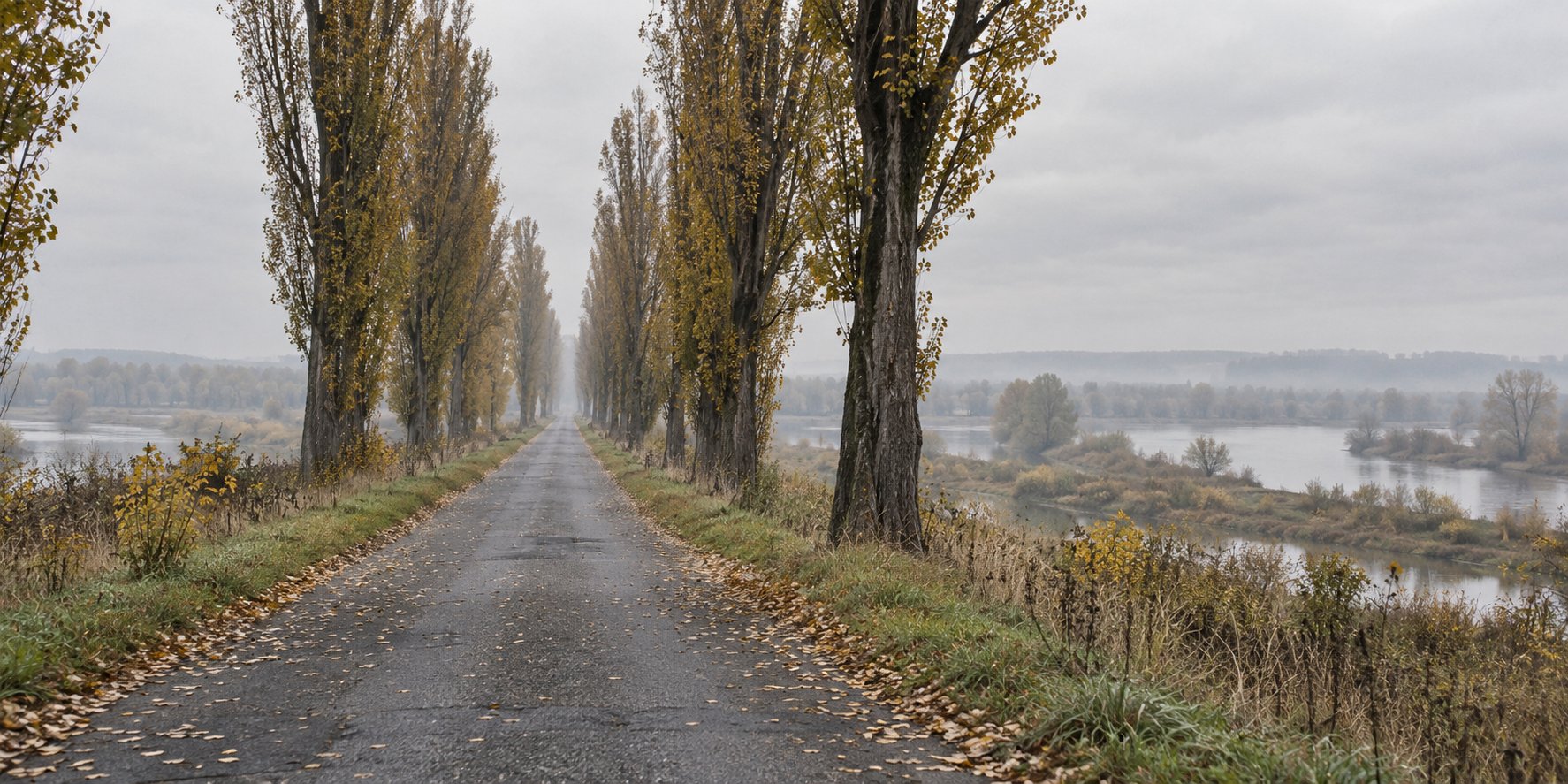
The road starts at the mouth of the Vistula, at Gdańsk, where the river meets the Baltic. Amber left this coast for the south from at least the sixteenth century BC. By the first and second centuries AD, when the road was at its peak, it ran from here to Aquileia on the Adriatic, through what are now five of the seven countries on our map. We drove it in the same direction as the amber, with the Roman stations as our itinerary and the vineyards as our reason.
There are no vineyards at the start. The Baltic end of the road is water, sand and wind, and the first day is mostly driving: south from the Vistula mouth, through the country of the Warta and the Prosna, the rivers the traders followed toward the Oder. It is flat and wide, and further than it looks on the map. We stopped for fuel and coffee and not much else.
We crossed the Oder near Krapkowice, where the Roman route crossed it. Downstream lie Wrocław and Lower Silesia, Poland's mildest wine country, and we made the detour. Granite in the Sudeten foothills, loess and sandy clay along the river, calcareous ground south-east of the city; Pinot Noir and Chardonnay do best. Of everything on the road, this is the part we import from and the part we know best. It is also where Poland's first appellation application is being made.
South of the Oder the road leads through the Moravian Gate and down into the Morava valley. This is Czechia, with 16,945 hectares of vineyard, 96% of them in Moravia: Znojmo, Mikulov, Velké Pavlovice, Slovácko. We stopped below the Pálava hills, Jurassic limestone rising out of the vines, and again at Znojmo, where loess lies over granite. The grapes here are Grüner Veltliner, Welschriesling, Pálava, Frankovka and St. Laurent, and the wines are as clear about their ground as any we tasted on the trip.
The Morava runs into the Danube, and on the Danube stood Carnuntum, the Roman amber hub. Today Carnuntum is an Austrian DAC, a wine appellation under the same name. Austria has 44,210 hectares of vineyard, 32% of it Grüner Veltliner, with Zweigelt, Blaufränkisch and Riesling behind it, on loess, gneiss and granite, shell limestone and basalt. It is a strange pleasure to drink a wine labelled with the name of a station on the road you are driving.
From Carnuntum the road turns south to Savaria, in Hungary. Hungary is the largest wine country on the road, with 55,581 hectares, and the most volcanic: basalt, rhyolite tuff, andesite, loess. We kept to the road and to the grapes on the lists we were handed: Kékfrankos, Furmint, Olaszrizling. We made one detour, to Somló, a basalt plug, because a road trip needs at least one.
Then Poetovio, and Emona, which is now Ljubljana. Both are in Slovenia, which has about 15,000 registered hectares in Goriška Brda, Vipava, Kras and Štajerska, on flysch, terra rossa over karst, and marl. The grape names change again: Rebula, Zelen, Pinela, Refošk, Šipon. So does the landscape, which tightens into hills, and the wines change with it, toward texture and skin contact.
The road ends at Aquileia, on the Adriatic, where the amber reached the sea. We ended there too, with a notebook full of names and a map with the road drawn on it in pencil. Of the countries we drove through, we import from one so far. The others are on the road ahead. We drove it to see what is waiting along it, and to remind ourselves that the line we draw on every page of this site was a real road, travelled for a very long time, before it was ours.