Place · 3 min · 10 August 2026
The limestone soils of Moravia
Jurassic sea floor under the Pálava hills, and what it does to Welschriesling.
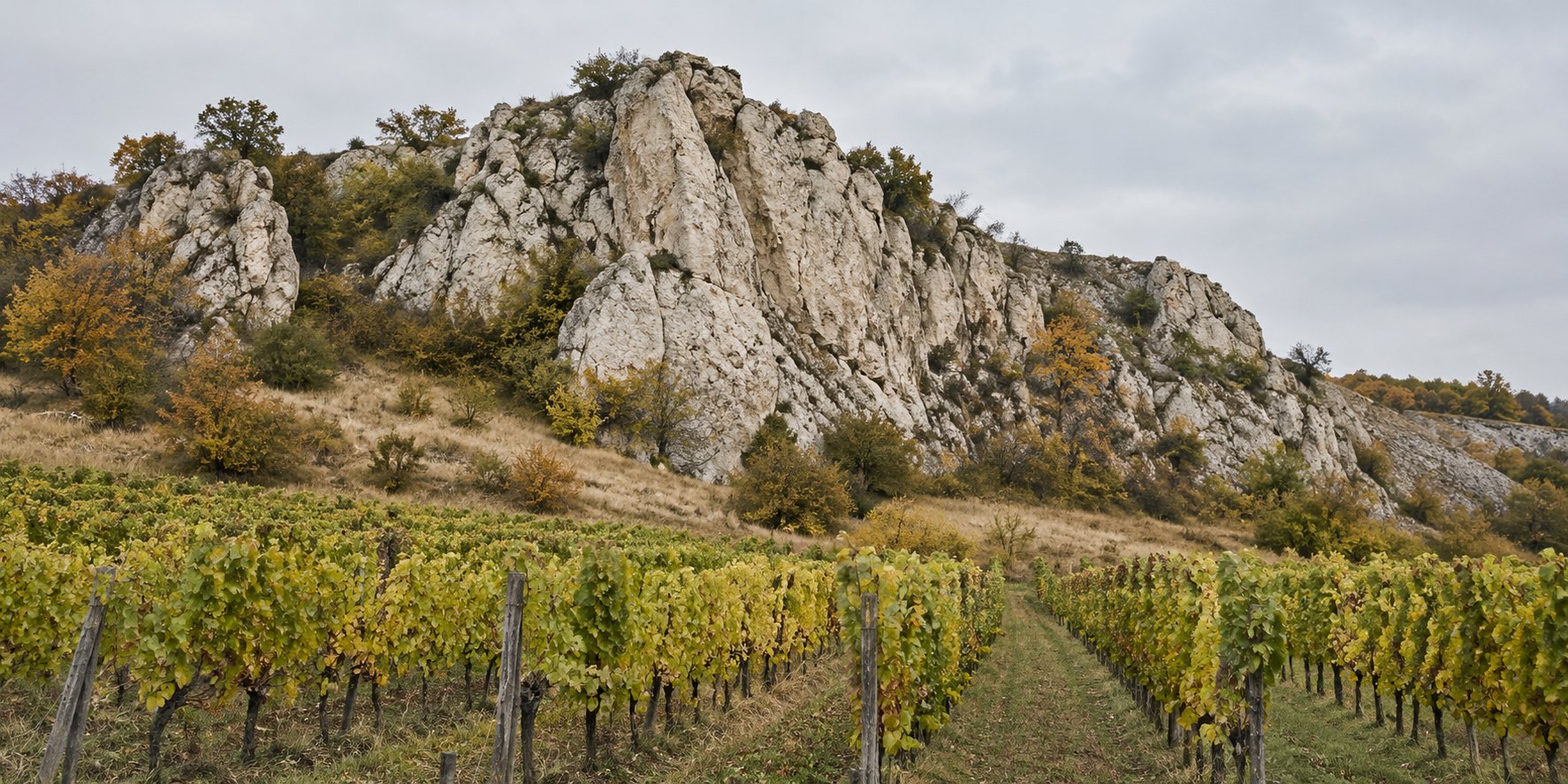
Moravia holds 96% of Czech vineyard. In 2025 Czechia had 16,945 hectares under vine, so almost all of it lies in the four Moravian subregions: Znojmo, Mikulov, Velké Pavlovice and Slovácko. It is a large wine country by the standards of the road, and a quiet one by the standards of the wine trade. We came for one hill and one grape, and for what the first does to the second.
The Pálava hills are where the ground changes. They are Jurassic limestone: the floor of a sea that is long gone, turned to rock. The same kind of stone underlies the Kraków Jura in Poland, and the resemblance is one of the reasons we keep coming back. Limestone is the soil we find ourselves tasting for, more than any other on the road.
Limestone does particular things to a vine. It keeps the roots cool and it slows ripening. In the glass it tends to show as high natural acidity, a saline length, and a tension that is easier to taste than to describe: the wine seems to hold itself in rather than spread out. Growers sometimes call this mineral grip. We prefer to describe what happens in the mouth. The fruit arrives, then stops, and the finish keeps going. On a deep, warm soil the same grape would ripen sooner and taste broader. On limestone it waits.
The grape that shows this most clearly, for us, is Welschriesling. Czech growers call it Ryzlink vlašský. In Hungary it is Olaszrizling, in Slovenia Laški rizling, in Croatia Graševina. Despite the name it is not related to Riesling, and its origin is uncertain. It is the most widespread white of this part of Europe, made dry, and in some places sweet. On rich ground it can be a plain wine: pleasant, fresh, quickly forgotten.
On the Pálava limestone it is not plain. The fruit is quieter, green apple and a little citrus, something like white flowers. The acidity carries more of the weight, and the finish runs longer and saltier than the fruit would suggest. It is not a loud wine. It is a precise one, and it makes the case for the soil more clearly than any section drawing or map we could print.
At Znojmo the ground is different, and so is the wine. There loess lies over granite. Loess is wind-blown silt, soft and quick to warm; wines from it tend to be rounder and more open, with aromatics that arrive fast and acidity that stays polite. Put a Welschriesling from Znojmo loess beside one from Pálava limestone and you have the simplest geology lesson we know, and the most enjoyable. Same grape, same country, same vintage, a short drive apart. The loess wine is the one you finish first. The limestone wine is the one you remember.
The limestone suits other Moravian grapes too. Pálava, the aromatic crossing of Gewürztraminer and Müller-Thurgau made in Moravia in 1953, grows here and shares the hills' name. So does Frankovka, the local name for Blaufränkisch, and St. Laurent among the reds. Across all of them the pattern holds: slower ripening, firmer acidity, a longer finish than the same grape gives on deeper, warmer ground.
Moravia has been smaller than this. At the end of the nineteenth century phylloxera left it with 3,800 hectares. It is also on our road: the Amber Road ran up the Morava valley and through the Moravian Gate toward the Oder. Czechia is on the road ahead for us; we do not import from it yet. When we do, we expect to start below the Pálava hills, with a glass of Welschriesling and a piece of the old sea floor on the table beside it.